
Hirose Ryōhei
広瀬 量平
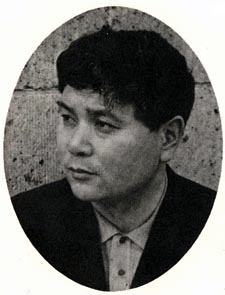
Born 1930
Composer
|
Ryohei Hirose was born in Hokkaido, Japan, in 1930, and studied composition at Tokyo University of Fine Arts and Music with Tomojiro Ikenouchi and Akio Yashiro. His works include instrumental, choral, and electronic compositions, as well as pieces for renaissance or traditional Japanese instruments. The Concerto for Violin and Orchestra (1979), premiered by Yuriko Kuronuma and the Tokyo Philharmonic Orchestra under Tadaaki Otaka, received its American debut in Carnegie Hall at the Music From Japan concert in January 1981. Hirose's career is marked by several major periods of development. After scoring a composition for traditional Japanese instruments to accompany a 1963 drama by Yoshie Horta, he received a succession of commissions for works incorporating various combinations of Japanese instruments. He became something of a champion of the shakuhachi during this time, when other well-known composers like Makoto Moroi and Toru Takemitsu were developing a curiosity about the instrument, but Hirose, who wished to return the shakuhachi to what he felt to be its essential roots, was clearly following a different path. In the 1970s, he began to move toward a more western approach, writing for solo percussion, harp, celeste, piano, cello, and viola, among other instruments. This new dimension came to occupy an equal position in his work with the composing for traditional instruments. In fact, they were opposite sides of the same coin: the voice of the solo cello for Hirose is fully capable of singing in timbres recognizable to the traditional Japanese inner ear. An interest in shamanism and deepening spirituality at this time received a sharp boost from two trips to India (1972 and 1973), reflected in a group of compositions during the following years, many of which have Sanskrit titles. Since then, Hirose's music has continued to mirror what seems to some the rough, untamed climate of his native Hokkaido. Through his use of Japanese instruments in a western idiom, one can hear Hirose hurling himself in opposition to various western moral concepts. Hirose has been awarded numerous prizes both in Japan and abroad. Among these are the Otaka Prize, the National Arts Festival Prize, the IMC (Paris) Prize, and the Festival D'Automne Prize.
|
|
|
Albums
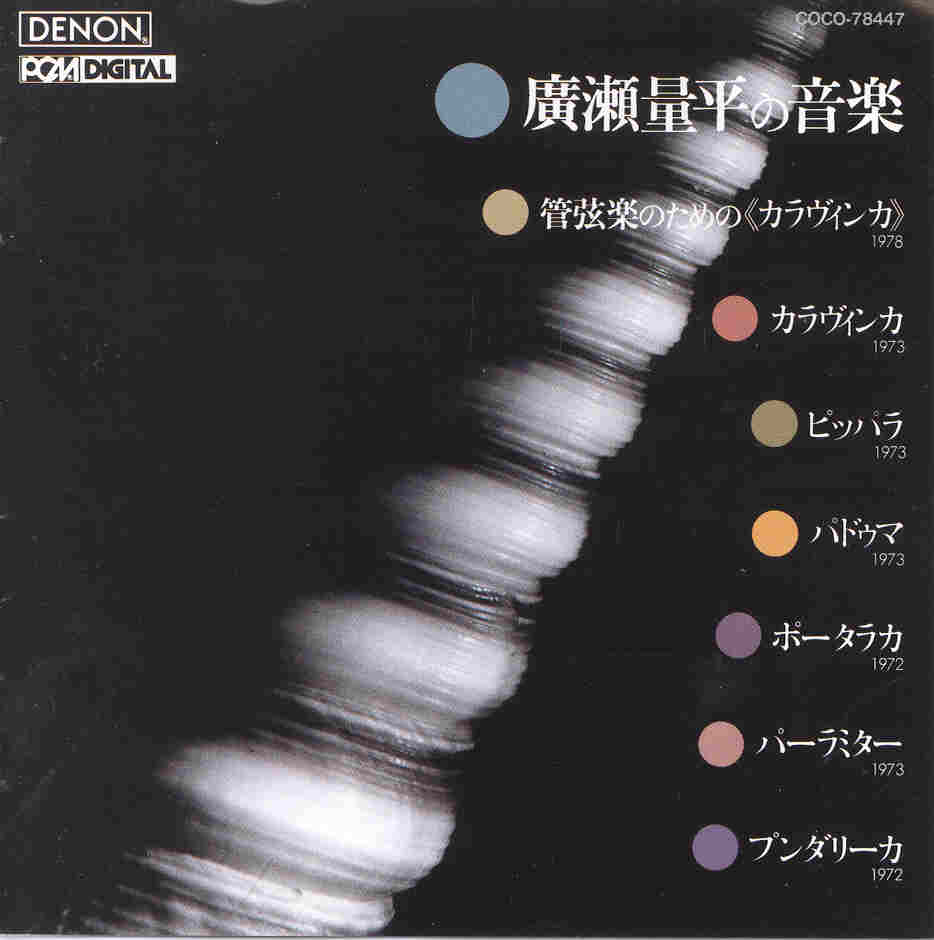 |
Hirose Ryohei no Ongaku |
Composed or Arranged
| Shakuhachi Compositions | |||
| Title | Kanji | Year | Alternate Title |
| Hina | ひな |
||
| Izayoi | いざよい |
||
| Shakuhachi Kyosokyoku | 尺八協奏曲 |
Shakuhachi concerto | |
| Shuko | 秋篁 |
||
| Yaki | ヤキ |
||
| Toruso | トルソ |
1963 |
Torso |
| Heki | 霹 |
1964 |
Composition for shakuhachi and strings Heki |
| Ryo | 涼 |
1967 |
Composition for shakuhachi - strings and percussions Ryo |
| Aki for Two Shakuhachi | 二つの尺八のためのアキ |
1969 |
|
| Hare | ハレ |
1969 |
Hare for 3 shakuhachi |
| Hi | 飛 |
1969 |
Composition for shakuhachi - strings and percussions Hi |
| Shu | 湫 |
1969 |
Composition for shakuhachi - strings and percussions Shu |
| Makimuku | まきむく |
1971 |
Quartet Makimuku |
| Byo | 渺 |
1972 |
|
| Kakurin | 鶴林 |
1973 |
|
| Vivaruta | ヴィヴァルタ |
1973 |
Vivalta |
| Yawatame | やわたの |
1973 |
Quartet no.2 Yawatame |
| Yumejuya | 夢十夜 |
1973 |
|
| Yukiaya | 雪綾 |
1975 |
Quartet Yukiaya |
| Tenraichikyo | 天籟地響 |
1976 |
|
| Tamafuri | 魂ふり |
1982 |
|
| Koto | |||
| Yō - Ten Steps for Koto Solo | 瓔 箏独奏のための十段 |
1972 |
|
| Metamorphosen of Midare | 1980 |
Publications
| Title | Kanji | Publisher | Year | Pages | Language |
|---|---|---|---|---|---|
| Shakuhachi 1969 |
Tokyo: Nippon Crown | 1969 | LP Sound Disc |